the cynical faux-realism of the brutalist.
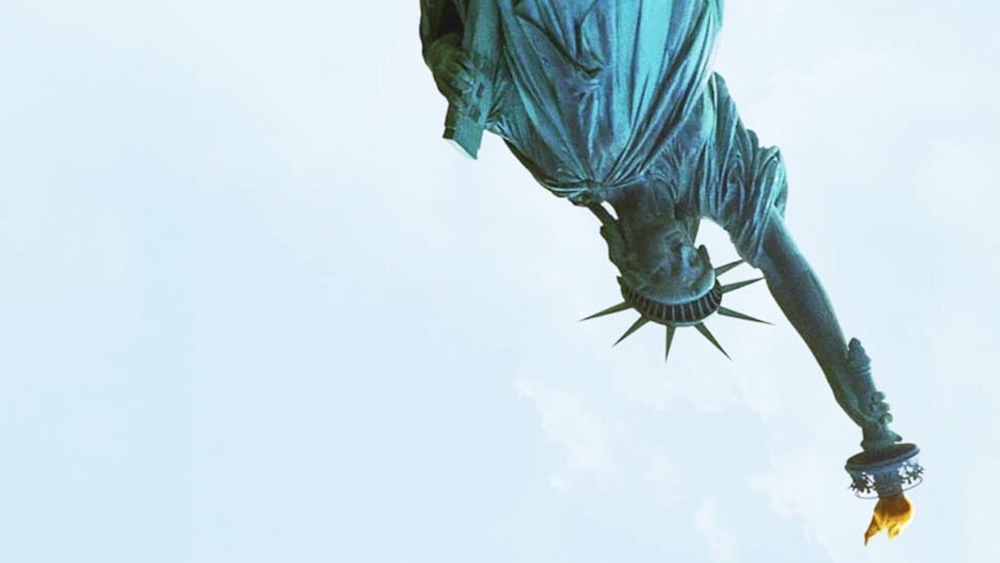
The Brutalist starts off promisingly. We emerge from the hull of an immigrant ship on a difficult cross-Atlantic journey to glimpse the Statue of Liberty. Only she is upside down. By the end of the film, however, the brutalism of the immigrant experience is less clearly topsy turvy and more just unrelenting misery. That’s one form of brutalism, to be sure, but it is not what the architecture was really about, even as metaphor. Brutalism was about getting down to functionality, being more honest about architectural materials and not trying to dress them up in froufrou. The architects and critics and theorists who developed it, especially in postwar England, were not particularly sadistic or even self-involved. Like the protagonist in the film, they drew from Bauhaus, but after that they were not particularly like him. For the most part, they sought out the simplified essence of buildings and built environments and what they might suggest for a more socialized, mass, democratic society. In doing so, they also often made spaces that for many felt unfriendly and cold, stripped of human-scale familiarity and livability.
Complicated stuff, this Brutalism! The Brutalist cares not a wit about any of it. Instead, it wants to brutalize its protagonist, the Holocaust-surviving modernist architect László Tóth, played by Adrien Brody as someone illegibly caught between being a wounded genius, a sad sap, and a drama queen. In brutalizing the main character, the film also seems to want to brutalize the viewer. By the time the film is done, Brody’s character encounters so many traumas—sexual, familial, ethnic, medical, drug-related, professional—that the overriding feeling is a kind of meaninglessness. What was the point? Everything is always going wrong, whether because of the character’s own foibles or for the venality of other figures in the film. (Side note: why is the main character named after Don Novello’s satirical letter writer from the 1970s, Lazlo Toth? Is that just another gag in a film that feigns historical gravitas? Or is it, in fact, part of the farcical black comedy quality of the movie?)
Perhaps the most brutal moment of all in the film is not the shocking penultimate scene (no plot spoiler here) but instead the epilogue, when the story shifts abruptly to a 1980s celebratory Venice Biennale retrospective about Toth’s architecture. Titled “The Hard Core of Beauty,” the final part of the The Brutalist takes place long after the main story, which is set in the post-World War II decades. We begin in a gondola (get it, we are back in a boat), the camera tilted at odd angles as we take in the architecture of Venice (get it, architectural monuments from another era, but also gesturing to the upside-down Statue of Liberty at the start of the film). The main character is still alive, but wheelchair bound and unable to speak, perhaps having suffered a stroke or some sort of illness that has rendered him unable to talk (more unrelenting brutality). His niece, who abandoned him to move to Israel since the United States seemed so unfriendly to immigrant Jews, gives a speech—somewhat ominously telling him “I speak for you now.” She steps to the microphone to speak. Is this his moment of redemption? Or will it be yet another act of betrayal?
The daughter, Zsófia, argues that Tóth was “above all, a principled artist.” His career was about trying to use buildings to describe how things “simply are.” They get at the, er, brutal truth. But then she turns his tale toward her own choices in life, not necessarily his. It turns out that Tóth’s masterpiece, the Van Buren Institute, the building whose troubled development occupied much of the film’s plot, was, Tóth’s niece argues, designed as a commentary on his experience at Buchenwald and his wife’s time at Dachau. Perhaps this was indeed the case, we cannot know for sure, but it certainly positions his story most of all as justifying her own turn toward Zionism. She then concludes: “No matter what the others try and sell you,” she claims her uncle told her, “it is the destination, not the journey.”
But, is it? And whose destination, whose journey? The epilogue scene, filmed partly in 1980s digital Betacam tape, with disco-pop music blaring and fancy-pants attendees nodding approvingly of the dioramas on display, seems almost parodic at times. As such, it retains the film’s overall cruel streak toward its protagonist—and maybe toward us, the viewer. Even this great triumph, this arrival, this destination, seems hollowed out and sour, turned to someone else’s needs and ideas, not László Tóth’s himself. There is a hard core of beauty here, or maybe the film is just trying very hard to be hardcore.
As the Big Lebowski might put it, bummer, man. What is the point of all this brutality? Is it to refuse easy answers? Is it director Brady Corbet’s effort to adopt an “I’m so tough” posture? There is not much tenderness to be found in The Brutalist. Of course the name of the film suggests as much. Was Tóth’s problem attributable to fallout from the Holocaust? Or was it the suggestion throughout the film of the main character’s repressed homosexuality during a time of homophobia? Or was the problem the larger xenophobia and class inequalities of twentieth-century America? Is the overall point all the pointless suffering? And how do all these brutalisms relate to Brutalist architecture, exactly, since it is ostensibly so central to the main character’s architectural vision? Is it merely the name that fit well for the film’s theme—or is it something more? Who knows, really? The Brutalist seems almost to want to brutalize us with its ambiguities, its irresolution, its sound and fury signifying nothing, its soaring pretentiousness. We’re left with the potpourri of a stinky life. One might label The Brutalist a kind of anguish pastiche, a biopic of a manic-depressive character in agony culminating in a niece‘s unctuous speech: self-justification disguised as filial homage.
Striving to present a story carved in neo-classical marble, making the point explicit by quite literally setting the most shocking scene of the film in a famous quarry in Italy, The Brutalist ends up feeling surprisingly glib and empty. It wants to hurt the protagonist—and us in the audience by extension. The movie seems most interested in exploring a kind of callousness, mistaking coldness for truth telling. The result is a kind of flimsy nihilism. Is this, in a way, the brilliance of The Brutalist? To help us see better how brutalism, American style, lacks the grandeur of Lear on the heath and more often consists of seemingly randomized fragments of hubris and bad luck, shitty friends and bad choices, broken trust and mistaken grandeur? Life doesn’t add up to much, the film contends, even when one leaves behind monumental works of art. The buildings, even when still standing, reduce us to ruins.
Brilliant? Or is this The Brutalist‘s failure? In trying to address the effects of dehumanization, it threatens to dehumanize. In mistaking cold-eyed realism for real life, it crushes all the possibilities of marble, stone, and concrete—and humans themselves—into crackpot realism. The film fools us into thinking that it is telling a tale about the redemptive majesty of architectural genius. Designing beautiful, spiritual spaces could be a way out of the slaughterhouse of history, The Brutalist might be suggesting, and visionary stubbornness triumphs in the end. Yet, the lack of warmth in the film, the profound alienation from which it refuses to budge, reduces all this hope to tatters and muck. Instead we get an ongoing saga of hardship, torment, and distress with no end. Even the epilogue seems like yet another wound, another disappointment, another betrayal, another charade.
The Brutalist reaches for a kind of determined toughness. It wants to see the world as it really is. Only the world is not only just obsessively bleak. To not see the brighter sides is to miss half the situation. Beauty is more than a hard core. That is what makes it interesting. Even Brutalism itself as an architectural movement was interested in many tones, modes, scales, and dynamics of human life between dark and light. Life simply contains more than brutality. And that’s where The Brutalist turns flimsy, its faux-realism a fantasy of cynicism. “No matter what the others try and sell you,” László Tóth told is niece, “it is the destination, not the journey,” but this film’s destination hardly feels worth it.