navigating colonial legacies with mónica de miranda’s path to the stars & tuan andrew nguyen’s the sound of cannons, familiar like sad refrains.
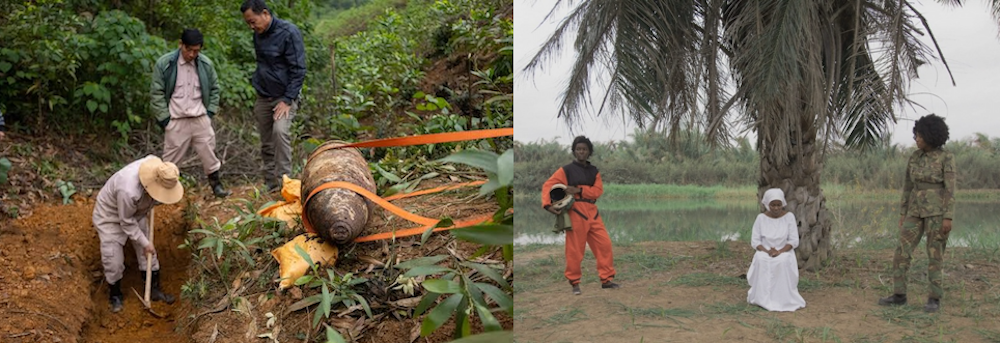
Both Mónica de Miranda and Tuan Andrew Nguyen have made haunting art films that measure the depths of colonialism’s wars and traumas without remaining trapped by the past. Miranda’s Path to the Stars (2022) explores the legacies of the Angolan Civil War while Nguyen’s The Sounds of Cannons, Familiar Like Sad Refrains (Đại Bác Nghe Quen Như Câu Dạo Buồn) (2021) investigates the American intervention in Vietnam and Southeast Asia. These dream-like films are built from rich but sometimes quite painful cultural references to poetry, history, popular culture, landscape, and religion. They are beautiful, mysterious, and, most of all, densely referential.
The films seem less interested in reaching Anglosphere audiences through explanation than representing lyrical evocations of historical connection and contrast through filmic montage and sequencing. Neither artist seems to care much if cultural outsiders grasp the details. Instead, they focus on conveying mood and atmosphere. For one in the know, the allusions are provocative and, I would think, powerful. For a newcomer to the histories of Angola or Vietnam’s anticolonial struggles, one picks up on the tone of each film even if you miss many of the references.
The films share a feeling of standing at a hinge, a bend, a seam. The colonial past lingers in the landscape (quite literally in Miranda’s film as figures and abandoned buildings on the shore and in Nguyen’s film in the form of unexploded ordnance). Yet these are not retrospective works. A future beckons in each that does not refute the past so much as incorporate it into beckonings toward something on the horizon. In some sense, these films do not turn away from colonialism so much as turn with it.
The two films also raise a question: in our increasingly globalized art world, what does it mean to receive such works in the Global North? What does it mean to watch Miranda’s film in a pristine gallery in Chicago or see Nguyen’s film on Vimeo? What does it mean to feel their moods even if the details are decontextualized? Is this just another instance of a clueless, or even harmful, colonial gaze? Does the artworld marginalize even as it receives, scrutinizes, incorporates, and celebrates? Possibly. Or does the stretch, the articulation, the twist across locations and understandings create opportunities for postcolonial interchange and elaboration? Maybe.
Neither Miranda nor Nguyen seem to worry much about the issue in the films themselves. Rather, they create densely suggestive, symbolic art. In doing so, they allow audiences both in the know and out of it to enter the atmospheres their films create even if not everyone tracks all the meanings. Indeed, the surfaces in both these films ride the depths. You might only see the ripples on the river of Miranda’s Angolan references in Path to the Stars, or merely taste the dust at the edges of Nguyen’s unexploded ordnance bomb hole, but there is more than information communicated; there is also feeling. Surface tension arises precisely from not quite understanding how to receive what swims below the waves or hides buried in the soil. The films is not unknowable in the broadest sense of the term. Their lack of explanation is part of the explanation. It’s on you, viewer. And even if you miss the semantics, passing through the gallery or perusing online, you can absorb the emotions.
Path to the Stars
Mónica de Miranda’s Path to the Stars begins with overhead shots of the Kwanza River, key passageway for the Portuguese to colonize the land. We see a boat on the water from directly above, as if from a drone. We pass by the banks of the river. An Angolese woman in military fatigues paddles up the river. We hear a woman reciting lines of poetry in Portuguese (with English subtitles). They seem to be reflections on a haunted riverine setting. One gets the feeling they might be quoting or referring to texts that already exist. She glimpses herself alongside the bank: a person looking back on her own history, perhaps on the history of the violent conflict that led to Angola’s independence.
The film’s cinematographic palette is consistently brown and green, emphasizing the river’s murky colorations. Soon the woman encounters an older woman in a black dress, perhaps her older self? This older figure pulls a red blindfold from her eyes and the two women converse. They stand in the small boat. They sit at a table. They quite literally eat hearts. Then we watch male soldiers tuning in portable transistor radios and glancing at star charts from China, remarking that “we’ll transport ourselves from here to there, beyond. These centuries have been an intermediary phase.” The main figure now floats in the river, looking like Ophelia among vines and water plants. We see a different older woman dressed all in white, sitting by the river stroking the hair of a young girl on her lap. Possibly, they are a mother and child. These imagistic moments pass by, scenes from a journey.
The sound design, by Xullagi, meanwhile mingles electronic squiggles and low-end pulsations with sounds of the jungle and the water. Now there are birds in cages on the beach. A soldier lies asleep in a bed by the river. The main woman in the film lays a flower upon him. He seems dead, or possibly just sleeping. Now old abandoned buildings that look like military barracks appear, and a younger Angolan women walking through them reflecting on the setting. Now a young Angolan girl appears, an astronaut dressed in red space suit with white helmet.
The main figure travels onward, up the river, in her canoe, looking around, breathing in the air, asking questions of those she meets, reflecting on a past of war and a future uncertain. Three young women with long braids, dressed in white dresses, dance around a fire. The smoke builds, sparks float by. They vanish. The woman in the canoe now holds a torch as she speaks.
Cut to a new scene in which one of the young girls appears with a bucket, drawing water from the river to dump on a larger fish on the sand. Then, in the next scene, an older man appears, seemingly in more modern times, wearing a hard hat, pouring dirt into a similar bucket.
We then see the young astronaut girl wandering the banks of the river, speaking of the stars, a kind of Afrofuturist hope in a film unafraid of confronting a history of struggle, even despair. The camera pulls away above the trees, to where the Kwanza River empties out into the Atlantic Ocean. The woman in military fatigues paddles out to the sea, speaking of how “a new territory grows closer.” Everything is metaphor. “I am foam on the wave,” she remarks. “I dissolve but I return. I only exist now and then.” She speaks of will, humanity, metamorphosis. She decides these are all “paths that run with the same names.”
Even without expertise of Angolan history, one senses from the dream-like and reflective tone of the film that much of the imagery and dialogue is drawn from sources mixed together. What of these details?
Mónica de Miranda explains in an interview with Art Africa magazine that Path to the Stars draws upon a number of sources, including a poem by Augustine Neto, the first president of Angola after it gained independence in 1975, as well as the dramatic masoleum built for him in the capital of Luanda, with its “Foguetão” or “Space Rocket” brutalist spire.
Marissa J. Moorman writes in an essay for the book No longer with the memory but with its future that the film also draws on work by Angolan writer José Luandino Vieira and Portuguese poet Cláudia R. Sampaio. Viera’s work, in turn, draws on a quotation about rivers by Langston Hughes.
There are also allusions to the work of Sarah Maldoror, the first filmmaker to explore the Angolese liberation struggle (she was originally from Martinique), and to visual artist António Ole’s film, On a Path to the Stars (1980), which payed tribute to Agostinho Neto.
Perhaps most evocatively, the film’s central character seems to be the Angolese guerrilla fighter Carlota, photographed in the book Jeszcze dzień życia (Another Day of Life) by Polish journalist Ryszard Kapuściński. Carlota became a mythical figure after dying shortly after the photograph was taken (Fidel Castro used the same name for the Cuban military campaign in Angola, but he drew from a reference to a Cuban anticolonial figure from the nineteenth century). Portrayed by actress Renata Torres, the central figure in the film—the protagonist, we might say—seems to be a kind of ghost of Carlota surveying her life and times by way of the river. She is also, however, a stand-in for women as part of the anticolonial struggle, hence the twinning and echoing of her by other female characters in the film.
And then there is the Kwanza River itself. It serves as a co-protagonist in the film, which Miranda describes as mingling past, present, and future. Moorman writes:
Born in Angola’s eastern Bié province, the river travels north and then west where it empties into the Atlantic. If the myth of Portuguese nationhood is wrapped up in the story of navigating oceans, made heroic in Luís de Camões’s poetic cycle Os Lusíadas, Vieira draws us to rivers, the pathways to and from Angola’s interior, to reframe Angolan national identity to the places where wars for sovereignty and against foreign control were fought, where culture swirls, while never forgetting the connections to other lands, rivers, and civilizations and the violent history that Hughes, Vieira, and de Miranda demand that we conjugate together.
There is a lot going on here, more than I as a non-expert can fully comprehend. Specific references, archetypes, allusions pass me by, but the feeling of the film cuts through: an urge to both pause time and flow past it; a feeling that the river, like the stars, might be a path to do so, or maybe not. These paths, transformations, experiences brought colonialism, suffering, and trauma to Angola by river; but the river keeps flowing, its currents moving.
The Sounds of Cannons, Familiar Like Sad Refrains
Tuan Andrew Nguyen’s The Sounds of Cannons, Familiar Like Sad Refrains (Đại Bác Nghe Quen Như Câu Dạo Buồn) takes us to the aftermath of the US intervention in Vietnam. We watch a split screen, evocative of the Woodstock film. On the left, footage of the US Navy’s 7th fleet from the 1960s; on the right, more recent footage of a Vietnamese team removing an undetonated bomb launched by that fleet into a rural village, where it has remained for over fifty years. Suddenly, the voice of the bomb speaks to us, reflecting on whether he was a failure for not exploding and how now he will be given a proper burial. Indeed, as military footage of the US ship, its guns, its crew, continues on the left, on the right we watch a group of men carefully lift up and then bury the bomb in is grave. The footage is slowed down for effect, to emphasize the care and the danger that the bomb—and all that it symbolizes—still contains.
“What will I hear in my next life?” the bomb asks us, “Is it that I’ve been influenced by the chit-chat I’ve had to hear all these years between the people, the trees, the rocks, the dirt, the animals speaking of spirits and reincarnation?” The bomb wonders: “What will I be in my next life? What’s the karma for bombs and bullets?” It stops to listen to a song, which begins to play.
The timbre of the recording, a hint of scratchy phonograph record, locates the music as coming from Vietnam during the American War itself. Trịnh Công Sơn sings in “Đại Bác Nghe Quen Như Câu Dạo Buồn” of a street sweeper, as the lyrics explain in Vietnamese with English subtitles. The street sweeper stops to listen to the sounds of a torrent of bombs. They frighten children in a rural village. When one lands on the shelter, it rips apart “golden skin.” The explosions of the bombs create flashes that become “the eye of our land.” All is terror and sadness. The quiet, lilting quality of the song intensifies the horror. This is a lament, but as with many laments, there is a fierceness to it, an anger just below the placid surface, a growing rage, a lullaby that remains fearfully subdued, suppressed and undetonated.
We listen and watch. On the left side of the screen, the gun turrets, all in a slanted row, do a kind of dance, a balletic chorus line, as they turn into place and fire from the ship offshore. On the right, the grave for the undetonated bomb is prepared in beautiful color shots of a verdant hillside. Sand is loaded into sandbags, orange rope tenderly wrapped around the bomb as its final place—where it will detonate and die—is prepared. As the song relates its terrible tale, the bombs are fired from the ship on the left while, on the right, the bomb explodes from within its trench, blowing dirt and smoke, dust and clots of ground in all directions.
Explosions, in this film, are not necessarily the loudest elements, however. Silence and quiet can seem even more ferocious. Tranquility holds indignation, ire, fury. We sense this when Trịnh Công Sơn’s song from 1975, “Đại Bác Nghe Quen Như Câu Dạo Buồn,” sung by Khánh Ly, begins to play in the film. The brushes gently scatter across the snare drum, the waltzing guitar chords pulsate, the piano arpeggios flutter, but the song does not stay at the gentle surface. It sinks right into the pit of the stomach. The song, Nguyen explained to Nguyễn-Hoàng Quyên in a 2025 conversation published in Brooklyn Rail, was “a pretty easy pick,” given its lyrics about bombs exploding, “but it wasn’t until I started translating it that I started to understand how Trịnh Công Sơn was thinking about sound and body.” For Nguyen, “There’s this really strong connection he makes between the sounds of these cannons far away and their impact on the body, the body of the people.”
Just so in the film itself. The far away and the immediate come together, the ferocious metal of weaponry; the softer sounds of night air and children sleeping. The hovering fear of two very different forces colliding: military technology and human flesh. The aftermath of it all, never quite an aftermath at all, just explosions followed by a deadly silences.
As with Miranda’s film, here too, time is at stake: the past moment of the war, the ongoing memory of it, its still living deadliness, influences the future, which cannot outgun what has occurred. A dud fails. Its telos, its intentions, only surface when subverted, when purposefully buried. The submerged erupts concealed. Not quite knowing the details is part of the larger ethos of the films. We infer what we cannot confirm. Wars, after all, do not end. Even when they do so formally, they leave behind more than they can contain. They are not chronological even as they unfold in time. The deeper creases matter even if one does not fully comprehend what is in them.
In these two films, war lingers. It does not end so much as transmogrify, mutating through cinematic reinvestigation, reorganizing, reminding, recasting—redirection is retribution, but revival carries no recompense. Even without quite knowing all the references, even if one lacks one’s own memories of these traumas, we can all hear war’s enormous repercussions, which resettle, but always by way of a recurring unsettling. Materiel lands like dust. An oar pushes into the ocean. We are not in the clear. Maybe returning becomes the point of no return.