as maga conservatives in the second trump administration attack not only marginalized americans, but also elite liberal elite institutions, can a revived and reimagined notion of solidarity help the left avoid being divided and conquered yet again by an increasingly authoritarian right?
Books Mentioned
- Dean Spade, Mutual Aid: Building Solidarity during This Crisis (and the Next), New and Expanded Edition. 2020; new and expanded edition, Verso, 2026.
- Sarah Schulman, The Fantasy and Necessity of Solidarity. Thesis/Penguin Random House, 2025.
- Valeria Graziano, Marcell Mars, and Tomislav Medak, Pirate Care: Acts Against the Criminalization of Solidarity. Pluto Press, 2025.
- Leah Hunt-Hendrix and Astra Taylor, Solidarity: The Past, Present, and Future of a World-Changing Idea. Pantheon, 2024.
- James Davison Hunter, Democracy and Solidarity: On the Cultural Roots of America’s Political Crisis. Yale University Press, 2024.
- Jodi Dean, Comrade: An Essay on Political Belonging. Verso, 2019.
Take a Knee
In 2020, allyship was all the rage. Democratic politicians such as Chuck Schumer and Nancy Pelosi took a knee and donned Kente cloth in the halls of American power in protest of the police murder of George Floyd.[1] Many liberals were suddenly reading Robin DiAngelo’s White Fragility or trying to learn from Ibram X. Kendi How to Be an Antiracist.[2] They were pondering the “1619 Project” in the New York Times and its call to use the first year Africans arrived in bondage to the British colonies as the starting point for histories of the United States. If they were not reading the Times or the trendy books on antiracism, their companies or institutions were suddenly forcing them to attend Diversity, Equity, and Inclusion workshops or, at least, watch Human Resources DEI videos online. It was a moment when equity—with its recognition of unequal starting points—replaced abstract equality as a buzzword. Concepts of police and prison abolition moved from remote activist and academic corners to the mainstream political arena for a time. A reckoning with the shortcomings of American history was underway even as Donald Trump captured the presidency in his surprising 2016 victory.
By 2020, even with the Covid-19 pandemic making public gatherings more risky, people of all backgrounds took to the streets to protest ongoing discrimination. So-called “wokeness” had arrived in full force, and not just for those directly affected, but also for a wider range of Americans who saw that even if they were not directly subject to unfairness and brutality, they needed to join forces with those who were suffering to do something. But what to do, exactly? Liberals and moderates were now, at least for a moment, swept into a multifaceted mobilization had been building since the turn of the millennium. It often started with marginalized groups organizing for their own interests, but now it also included more privileged Americans. Exciting times; but challenging ones too. The questions of how to sustain coalitions across differences of class, race, gender, and other social positions became grew. The issues of forging alliances between the left and liberals, those more radical and those more centrist, intensified. How were those not directly affected by injustice to join—or at least support and work with—movements that were not directly their own? Could they do so without distorting those movements, taking them over, or usurping the agency of the very disempowered populations they wished to support?
The concept of allyship blossomed to address this dynamic. The idea began, in many respects, in the 1960s Civil Rights Movement when white participants unintentionally usurped roles of leadership in a struggle for Black Freedom whose purpose was to empower Black Americans not reproduce the hierarchies of Jim Crow segregation and decades of prejudice and injustice in a more polite form.[3] It gained traction in the 1990s, invoked to signal heteronormative support for queer, gay, and transgender people.[4] By the 2010s, everyone was becoming an ally (think of Schumer and Pelosi’s stunt).
After the re-election of Donald Trump in 2024, allyship produced powerful instances of resistance. Americans who were, themselves, unthreatened by ICE’s roundup efforts, nonetheless chose to organize, fight, and support immigrants under attack. A few even died as allies in the struggle to stop ICE. Despite the heroism of many activists, however, allyship has also shown its limits, too. It has helped at times with disparate single-issue concerns, but, as of yet, it has failed to produce a robust, long-lasting, and winning political mass movement. If anything, the authoritarian right has grown in power. It has done so, at times, precisely by mocking ideas of allyship between elites and marginalized populations.
Just as allyship has had moments of effectiveness, but failed to catalyze a sustained left-liberal alliance that can win elections and shape policy, so too the more radical politics of horizontalism, which rose to prominence in the 2000s and 2010s, has not led to transformative power. The idea gained traction after the demise of communism in 1989, which revealed the profound failures of top-down, undemocratic forms of socialism. It got supercharged by the connective power of the Internet and social media in the 1990s and first decades of the twenty-first century. One saw this new form of radical politics burst onto the scene as early as the 1999 World Trade Organization Protests in Seattle, but it truly gained attention in the Color Revolutions of former Soviet states and Middle East and was most on display in the aftermath of the 2008 Great Recession when the 2011 Occupy Wall Street Movement took off. Various democratic uprisings around the world (in Brazil, Hong Kong, South Korea, Indonesia, and elsewhere) drew upon the turn toward decentralization and spontaneous revolt. Even movements such as Black Lives Matter and MeToo had horizontalist qualities. They began as online tags before they went viral and led to marches and organized protests. It was all tremendously exciting for the left, but as Vincent Bevins notes, the initial explosions of democracy in the streets without clear ends, demands, or structures often allowed more moderate “allies” to dilute them (allyship at its worst). Or, more troublingly, reactionary elements stepped in when the initial excitement abated, as happened in Brazil with the Movimento Passe Livre in 2013. As Bevins observes, in the age of social media, mobilization had never been so easy but actual organizing never so difficult.[5]
Forging Connection in an Age of Loose Affiliation
Allyship and horizontalism seem like different issues, perhaps, but they share a common theme: the turn toward looser forms of affiliation that do not arise, necessarily, from deeper bonds, foundations, or commitments. Quite useful for broadening the fight for marginalized groups, allyship and horizontalism have not been able to sustain effective alliances over time. Allyship has had a troubling tendency to wind up emphasizing the stories of the allies themselves while minimizing those with whom the allies seek to serve. Just think of the attention given to white, middle-class anti-ICE activists who died compared to the names and stories of immigrants who have been deported, injured, or killed. Similarly, horizontalism made possible new forms of protest, but it lacked the strategic tools to drive forward a philosophy change that could deliver the goods. In fact, it often gave too much power to the pesky few who consistently broke rank rather than the majority of activists willing to achieve an imperfect consensus. There have been positive developments. Events such as Occupy fed the rise of the Democratic Socialists of America, Bernie Sanders improbable presidential runs of 2016 and 2020, the election of “the Squad,” and the mayoral victory of Zohran Mamdami in New York City, but these developments on the left arose, in many respects, precisely in response to horizontalism, not as expressions of it. We remain in search of a concept that might satisfyingly help to build a stronger “left wing of the possible,” as Michael Harrington famously called it.
Meanwhile, authoritarianism grows. When powerful liberal politicians took a knee wearing Kente cloth in response to the killing of George Floyd, they revealed how allyship could become superficial, more performative act than substantive commitment. Even in 2020, the publicity stunt struck many as farcical, but horizontalist attitudes lacked the capacity to hold figures such as Schumer and Pelosi to account. Now, their knee kneeling in Kente cloth seems downright quaint. Whatever possibilities “wokeness” opened up in the 2010s has been crushed by a second Trump term. Most shockingly, the era of Trump the Second has seen MAGA conservatives applying enormous pressure on the institutions of elite liberals themselves. Once thought untouchable, these bulwarks of American life increasingly face withering attacks. Not only marginalized populations, but also centers of bourgeois liberal life such as legal firms, universities, healthcare providers, nonprofits, and NGOs are directly threatened. Which is to say that, after 2024, the right has increasingly assaulted both the masses of less fortunate people andthe liberal elites who have sought, both substantively and symbolically, to ally with them.
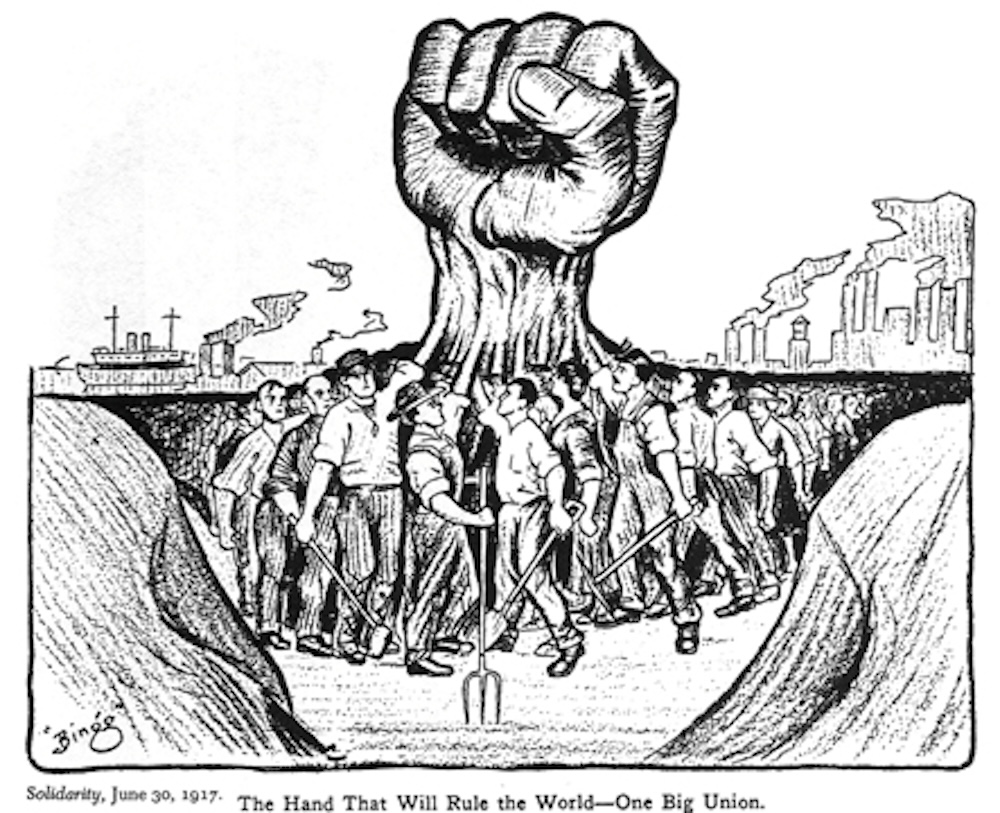
For many on the left, allyship and horizontalism seem increasingly inadequate as responses to a rising authoritarian tide. Enter—or, better said, re-enter—the concept of “solidarity.” The term originally suggested common cause among those with shared circumstances and grievances. Think of workers being exploited in a factory or peasants trapped in feudal land ownership regimes. Today, it has begun to take on new characteristics. As Sarah Schulman acutely notices in one of the best new books on the topic, solidarity increasingly speaks to alliances not among those with a similar lot in life, but rather those reaching across hierarchies of power and inequality to forge alliances. In a more complex, dispersed, gradated, and globalized society, we have gone from “solidarity forever” songs to “in this house we believe” signs. We have moved from “workers of the world, unite” manifestos to “immigrants are welcome here” fliers. The question arises: can “solidarity” survive the transition from connection forged by commonality to affiliation developed across difference? Nothing less than the future of a democratic United States may be at stake in how one answers the question.
Forms of Solidarity: Transformative, Partial, Provisional, Mutual, Pirate & Fuzzy
Leftwing activists Leah Hunt-Hendrix and Astra Taylor are curious about developing a usable past of the term by way of a deep intellectual history that leaps across radical movements of the past. Unlike “the countless treatises on the evolution and significance of justice, liberty, equality, and democracy that line library shelves and make up the canon of Western political thought,” they note that there has not been “a more holistic assessment or sustained reflection on the concept of solidarity itself.” Surveying political struggles and social movements across place and time, from abolitionism and socialism to Roman debtors and French Revolution Jacobins, they grow most interested in what they call “transformative solidarity,” or the organized effort to “expand the circle of inclusion while also altering society’s very character.” For Hunt-Hendrix and Taylor, solidarity is most definitely of the type that strives “to build bonds of commonality across our differences” not identify sameness of grievances. Therefore, it holds the key to contemporary dreams of changing the world for the better. Because “transformative solidarity is grounded in equality and reciprocity,” they believe it stands “in contrast to the hierarchical tendencies of allyship, altruism, charity, and philanthropy.” Solitary, for them, is a deeply felt commitment to others not like oneself in the name of coalition building. It is the glue that can hold together disparate peoples interested in progressive change when their opposition on the right seeks to divide and conquer them.
Much like Hunt-Hendrix and Taylor, Sarah Schulman also turns to the concept of solidarity. Like them, she combines intellectual history with experience in direct activism. Unlike Hunt-Hendrix and Taylor, however, Schulman is far more frank about the challenges solidarity builders face. “The kind of solidarity addressed here,” she explains in her book, “is rooted in inequality” and “is by definition fraught.” She turns to examples that are not triumphant, as Hunt-Hendrix and Taylor do, but rather ones that are “both failed and partial solidarities.” Schulman draws upon her own experiences as an ACT UP participant during the fight against HIV AIDS in the 1980s. She probes the quirky solidarities expressed by the painter Alice Neel. And she is especially nuanced when bringing to the surface Jean Genet’s flawed political commitment to Palestine as a gay man attracted to Arab partners Schulman comes to believe that solidarity is not exactly the answer to achieving radical change, but nonetheless it remains an essential component—a starting point. It is, as her title puts it, both a fantasy and a necessity. When attempted, even partially or imperfectly, it sets the stage for “repair” and maybe even for transformation. Solidarity may not be the glue that Hunter-Hendrix and Taylor wish it to be, but for Schulman it is something like a burning ember, a fever dream, a glow in the ashes, that can produce sparks.
Schulman’s focus on “repair” appears in elaborated forms in Dean Spade 2020 book Mutual Aid: Building Solidarity during This Crisis (and the Next), now out in an expanded edition, and Valeria Graziano, Marcell Mars, and Tomislav Medak’s fascinating Pirate Care: Acts Against the Criminalization of Solidarity. These are both how-to manuals for activists, but with theoretical heft behind them. They also bespeak the lingering interest in anti-statist, anarchist politics on the left. Written in the heat of the Covid-19 pandemic, Spade bemoans the narrow focus of professionalized “help” from elites for people who are suffering. Frustrations with NGOs and special interest groups led Spade to argue for “groups doing mutual aid to directly address real problems in real people’s lives.” These activities, Spade contends, “tend to develop a multi-issue and solidarity-based approach because their members’ lives are cross-cut by many different experiences of vulnerability” and, crucially, they can lead people to “adopt a wider horizon of solidarity and a wider vision of political possibility if they use the mutual aid model.”
Graziano, Mars, and Medak go a step further. They want to connect romanticized aspects of historical piracy—understood as rebellions against centers of empire, as rough democracies of resistance—to the work of caring for others directly, as in health services, education, and other forms of social maintenance. Picture a pirate ship sailed not by peg-legged, one-eyed rogues under a skull and crossbones flag, but instead nurses, teachers, nannies, custodians, plumbers, carpenters, IT staff, mothers, family, and other workers who do the actual labor of social reproduction. This is a book that defends horizontalism, but has its cutlasses drawn and ready to slash away at the idea of “allyship.” Liberal allies, who needs ‘em? So propose Graziano, Mars, and Medak. Instead, they contend that people can do it themselves. Work outside the surveillance and control of neoliberal, technocratic elites leads to “defiant practices of solidarity,” Graziano, Mars, and Medak believe. “Unlike those institutions of Empire’s matrix of care,” they write, “the strengths of pirate care are its multiplicity, plasticity, opacity, and capacity to adapt to local conditions, contexts, and opportunities.” For the trio, “pirate care is a frame within which to observe corresponding forms of militancy and to make new alliances.” Out of this “federating together” of “various forms of disobedient care,” they think that “we can build our capacity to break free of Empire’s failing care regimes and grow autonomy in social and ecological reproduction, creating a virtuous circle that fosters new insurrections.” Up with horizontalism and its ability to foster solidarity, down with elite allies.
It’s a noble vision, and one echoed by Jodi Dean in her far less anarchistic and far more conventionally socialistic use of the term “comrade” in her book of that name. A professor of political science at Hobart and William Smith Colleges, Dean does not shy away from a more traditional communist politics, with its commitment to centralized power and individual sacrifice. For her, “Comrades are those who tie themselves together instrumentally, for a common purpose.” Comradeship generates “an intensity of feeling and expectation of solidarity that differentiates those on one side from those on the other.” It “is a political relation of supported cover.” No pirate democracy here; more central committee organization and command and control.
Dean aims to fight, and she aims to win. You are either with her, or against her. “Comrades,” she believes, “are those you can count on.” Why? Not because you are forging solidarity across difference, but rather because “You share enough of a common ideology, enough of a commitment to common principles and goals, to do more than one-off actions. Together you can fight the long fight.” There might be disagreement, but it is put aside. Action does not come from “allyship,” with its focus on individual self-improvement from afar in the name of social change.” If anything, “allyship is a symptom of the displacement of politics into the individualist self-help techniques and social media moralism of communicative capitalism.”
Comrades engaged in revolutionary struggle may form “provisional allies” with the likes of liberals or anarchists, but these are not comrades. Instead, Dean asserts that comrades embrace the need for hierarchical structures born of their enduring effort to overthrow capitalism and end its degradations. In her communist vision, “Comradeship binds action, and in this binding, this solidarity, it collectivizes and directs action in light of a shared vision for the future.” We are back to an older type of solidarity here: not alliances or coalitions across lines of social difference, not the magical powers of self-determining horizontalism, but the forging of sameness out of comradely acts of committed resistance.
If Dean takes us all the way back to a sort of Leninist politics—a hardcore, communist vision of solidarity—James Davidson Hunter goes in an entirely different direction. The sociologist and scholar of religion offers a broad survey of US intellectual traditions very much in the liberal democratic vein, with a good dose of Protestantism. No socialism, anarchism, allies, or horizontalism to be found here. Instead, Hunter returns to the concept of solidarity as conceptualized by the German sociologist Emile Durkheim. For him, solidarity is neither a long durée of radical action, nor a mode of resistance from the margins, nor a means of forging alliances across distance in the name of social transformation. It is, merely, a structuring form of “cohesion,” a deep-seated framework of culture, a common set of beliefs, attitudes, values, and outlooks. “The power of solidarity,” he writes, “is found in the unspoken, often vague or fuzzy resonances of shared identity, shared affections, shared challenges, and a shared destiny.” For the more radical theorizers of solidarity, it creates a culture; for Hunter, however, culture creates it.
In the case of the United States, Hunter believes that the country developed a distinctive “hybrid-Enlightenment” tradition that combined secular rationalism with a “religious imaginary that provided assurance that America was a nation existing under the guidance of Providence and moving toward the millennial hope of a world made new.” Calvinist in its formation, this American sensibility “was still broad enough and opaque enough for people and communities of widely different backgrounds, experiences, convictions, and interests to find their place and contend within it.” The problem today, he concludes, is that the cultural solidarity of this shared framework has fragmented. It has become impoverished. Americans have lost faith in its accuracy, never mind its efficacy. While past struggles and disagreements, even bloody ones such as the Civil War, took place within its contours, in the twenty-first century both leftwing and rightwing activists have rejected the idea that with the “working through” of secular reason, the special religious mission, the exceptional role, the destiny of the United States, to bring about a better world could be realized. Instead, the underlying belief in secular reason and debate driven by a shared “hybrid-Enlightenment” religious faith has come undone. In its place, a growing cynicism, a nihilism, a feeling of total war with others in the face of no future, no prospects. Americans of the world, disunite! You have nothing to lose.
Despite his Niebuhrian bleakness, his grieving of the loss of a more Deweyian form of sentimental hope in human civic togetherness without some kind of secularized but providential Protestantism to undergird it, Hunter glimpses moments of potential democratic revival in the United States. “The hybrid-Enlightenment,” he contends, “as it has been reworked over the centuries, still resonates with many Americans.” There are “many with a desire to continue the hard work of working through the contradictions that remain in American public life.” Yet the solidarity for it—the cohesion brought about by a shared cultural line that runs like a sort of Cotton Mather thread through the fabric of American history—has been torn asunder. For Hunter, solidarity cannot hold the United States together politically because “the cultural resources for doing that hard work have dwindled to naught.” Worse yet, “the cultural logics that have replaced the nation’s underpinning sources of unity present challenges that render the renewal of democracy even more daunting.”
A World Made More Solid?
Hunter clings to a liberal democratic ethos. His is not a radical critique of it. Nonetheless, his distinctive use of solidarity suggests that he misses the commonalities his hopes and commitments share with activists to his left, from Hunt-Hendrix and Taylor to Schulman to Graziano, Marcell Mars, and Tomislav to Spade. They locate their politics in more radical sources, to be sure, but they also fervently share his dreams of democracy. They are no nihilists. Even Jodi Dean, who diverges about as much as one could imagine from Hunter, agrees on this. While one imagines that she would vehemently reject his historical narrative and sneer at his lack of a Marxist condemnation of capitalism within his continued American exceptionalism, she, just like Hunter and the other writers considered here, still hopes for a more just, free, and healthy society. There is a hint of providence lurking in Dean’s communist comradeship too, just as much as in Hunter’s liberal democratic faith or Spade’s mutual aid or Graziano, Mars, and Medak’s pirate care.
In these authoritarian times, the allyship and horizontalism of recent decades can seem increasingly naïve and foolish. Solidarity suggests something tougher and, potentially, more enduring. That does not mean, however, that it is not just as utopian. Thinking about the term’s content, its contours, and its implications might even provide a prefigurative peek of the very society that solidarity aims to bring into being. At the very least, in a world ever more fragmented and broken, atomized and isolating, nihilistic and despairing, the struggle to understand what solidarity means is perhaps one step forward in the long march to a world made more solid.
[1] Alicia Lee, “Congressional Democrats criticized for wearing Kente cloth at event honoring George Floyd,” CNN Politics, 8 June 2020, https://edition.cnn.com/2020/06/08/politics/democrats-criticized-kente-cloth-trnd.
[2] Robin DiAngelo, White Fragility: Why It’s So Hard for White People to Talk About Racism (Beacon Press, 2018); Ibram X. Kendi, How to Be an Antiracist (One World, 2019).
[3] See Charles M. Payne, I’ve Got the Light of Freedom: The Organizing Tradition and the Mississippi Freedom Struggle (University of California Press, 1995); Winifred Breines, The Trouble Between Us: An Uneasy History of White and Black Women in the Feminist Movement (Oxford University Press, 2006); and, especially, Alice Echols, Black Power, White Heat: From Solidarity Politics to Radical Chic (Oxford University Press, 2026).
[4] Wendy Marie Cumming-Potvin, “What Is Allyship? A Brief History, Present and Future,” The Conversation, 15 May 2024.
[5] See Vincent Bevins, If We Burn: The Mass Protest Decade and the Missing Revolution (PublicAffairs, 2023).