history gets untethered & we are left with the problems of caricature.
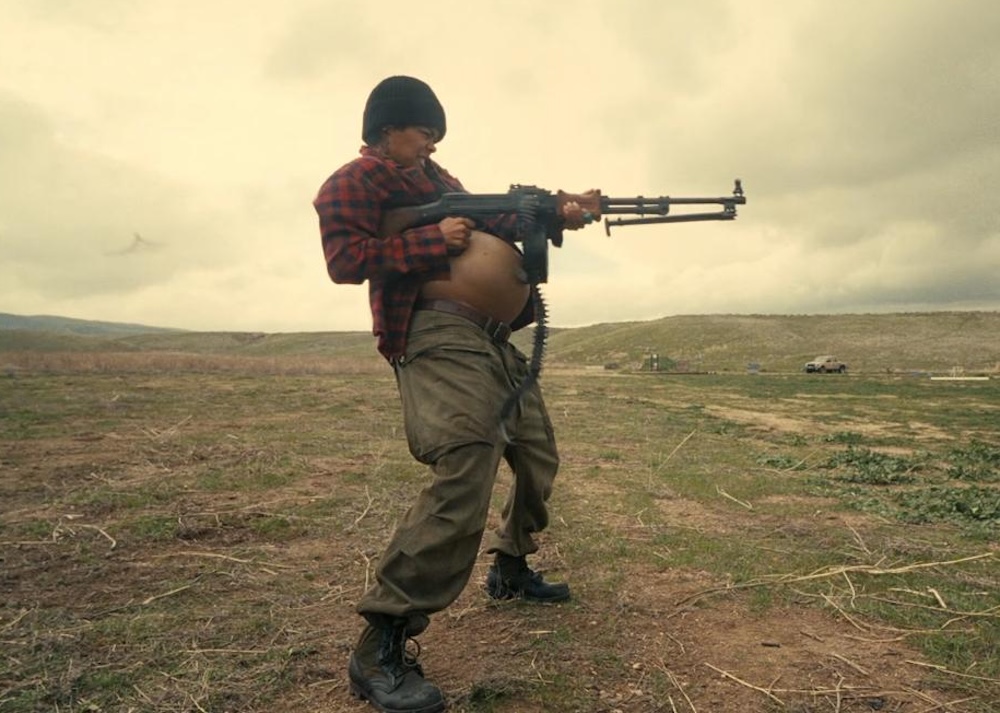
Paul Thomas Anderson’s One Battle After Another achieves much by loosening the historical specificity of Thomas Pynchon’s 1990 novel Vineland, upon which the film is based. Whereas Pynchon’s novel carefully locates its story in a 1980s Northern California hippie hideaway of pot growers and a few later-day radicals, the film cuts loose into an ambiguous temporality, sometimes taking place in a 1970s Weatherman Underground anti-Vietnam War past and sometimes in an authoritarian Trump-era present. It’s as if Anderson wants to emphasize the After Another part of his film’s title more than the One Battle. The film seems to want to chase Vineland‘s ongoing entanglements, placing its specific moment in a larger, continued story of imperial conquest and oppressive injustice (and resistance to these forces) that stretches from the Vikings to the Indian Wars to Vietnam to the contemporary violence of ICE. Not just one battle, but many; not just one vine, but a jungle.
There is enormous energy and power in this departure, a supercharging of the novel’s energies that leads to the film’s thrilling final, woozy chase scene. However, there is also a profound problem. Anderson has retained the cartoonish dimensions of Pynchon’s fiction, the way the author likes to satirize society by creating ridiculous names and oversized characters, but the director has lost Pynchon’s skill at locating these in very precise historical milieus.
What we are left with is the excitement of potential continuities, but the dangers of decontextualized caricatures. This is most noticeable, even outrageous, in the portrayal of Perfidia Beverly Hills as a stereotype of white male fantasies about Black female sexuality. Actress Teyana Taylor tries to bring out other dimensions of the character, but Anderson’s camera is like a cliché of the white, male gaze and his script keeps making her an object of fantasy rather than a figure of complexity.
Of course, it is Perfidia’s inner complexity that drives the entire plot! Her choice to pursue revolutionary violence, her attraction to power in both emancipatory forms and in more troubling ways, is the absent present of the entire affair. But absent it remains nonetheless. In its place, we only get a kind of minstrel show Black Pantherism, a projection of white male desires of all sorts onto the Black female figure. This is not the story of a Black female revolutionary; it’s the story of a rather mopey, washed-up revolutionary white man’s feelings about a Black female revolutionary.
Not that Thomas Pynchon himself is some genius of female or Black subjectivity. His books are pretty male-oriented too and pretty white-oriented. In the novel, Frenesi Gates—the seeming inspiration for the Perfidia Beverly Hills character—shares some of the same tortured relationship to power, but in far more sophisticated, subtle, and less objectified, eroticized forms. She is a radical woman from the 1960s too. She commits revolutionary violence too. She has affairs with federal law enforcement agents too. She is a kind of ghostly presence for her former partner Zoyd Wheeler and her daughter Prairie Wheeler too. What she does not do as a character is display the outlandish conflations of sexuality and radical violence that Anderson amplifies to a scream in the film. Gates is a not an uncartoonish character in Pynchon’s novel, but she remains a compendium of historical references and scenarios folded into a complex figure, not just a foxy lady with a machine gun. As an actor, Taylor tries to get Perfidia Beverly Hills to a more intriguing, sophisticated place as best she can, but throughout One Battle After Another she’s fighting Anderson’s intensified, historically unmoored adaptation as much as the various right-wing fascists.
This stands in stark contrast to Latino Sensei Sergo St. Carlos, played wonderfully by Benecio del Toro. He gets to occupy a cool cat revolutionary, also a bit of a cartoon, but one whose bold form nonetheless contains more subtlety and range: funny and humane, not merely sexualized. The character is a revolutionary, full of audacity, but also full of camaraderie and warmth as well as a fierce commitment to social transformation. He’s the one character who feels most connected to the spirit and vibe of Vineland, in which the ghosts of the 1960s resurface in the foggy mists of the Northern California redwoods.
There has always been a good dose of the comic book in Pynchon’s fiction. Perhaps this is the quality that has drawn Anderson to make films of Pynchon’s books. First, Anderson did so with Inherent Vice, and its sandal (instead of gumshoe) detective wandering the darker corners of a psychedelically noirish Los Angeles, and now Anderson has done so with Vineland. Yet Pynchon’s novels are historically rigorous alongside their comical exaggerations and spoofs. The gags do not become one dimensional because of their cartoonish qualities tend to stay closely connected to history. Pynchon puts in absurdist bits with a precision to the past. This allows his books to construct characters as complex wholes despite the humorous references.
Perhaps it is the insistence on keeping the details of the novels tethered to history that Anderson abandoned in his excitement about Pynchon’s books. Transforming Frenesi Gates into Perfidia Beverly Hills allows her to loom large over the film, to cast a shadow over counterpoints such as sad sack “Ghetto” Pat Calhoun, now Bob Ferguson, played as dopey but determined by Leonardo DiCaprio, and the stupidly ridiculous Col. Steven J. Lockjaw, played even more straight out of a comic book by a hilarious Sean Penn. His character is truly one-dimensional, with a walk that suggests he literally has a stick up his ass.
Perhaps the film’s characters are caricatures for our clownish times. Everything in the 1980s, when Pynchon was writing Vineland, seemed to affirm of the 1960s that Marx was right way back in the 1850s: history repeats itself, first as tragedy, then as farce. What does this make, then, of the 2020s? What comes after farce? The answer surely cannot be the persistence of stereotypes or the reduction of people to a projected fantasy upon their bodies. This conveys only the limitations of 1960s imaginaries loosened from their historical moment to bleed across other moments, other figures, other times. It leaves the 1960s to float like suffocating smoke over those trying to find a way beyond the battling. I can’t breathe, you might hear these characters and whom they represent saying.
Could we, instead, search not for a grim sense of recurrences—like mother, like daughter, as the film suggests at its end—but instead look for historical ruptures? One glimpses this alternative, this break, in the film when the authorities interview various kids from the high school of Perfidia-Bob daughter Willa Ferguson, played by Chase Infiniti (whose actual name sounds straight out of a Pynchon novel!). Appearing in various forms of gender nonconformity and diversity, the friends and fellow students point to forms of selfhood that the 1960s could barely begin to picture, never mind make cartoons of them.
Perhaps this is a moment in the film when something stops repeating and other potentialities peek out. These are the characters who seem to yearn to move beyond the walls of the cartoon strip panels found in both Pynchon’s books and in Anderson’s film. Along with the hidden community of immigrants Sergo St. Carlos tries to protect and the phalanx of quiet skateboarding rebels who help him to do so, they suggest a kind of person looking beyond one battle after another. They care not a whit about the 1960s or the 1980s. They are looking for their own histories.
Maybe the problem, both in One Battle After Another and in the Trump era as a whole, is not that it is new so much that it is so stuck in the past—the boomer past in particular. How might we “break on through to the other side” in a way completely different from how the 60s rebels tried to do so? What might come after one battle after another?