soundtrack to a coup d’etat sounds out changes & continuities in geopolitics since the depths of the cold war.
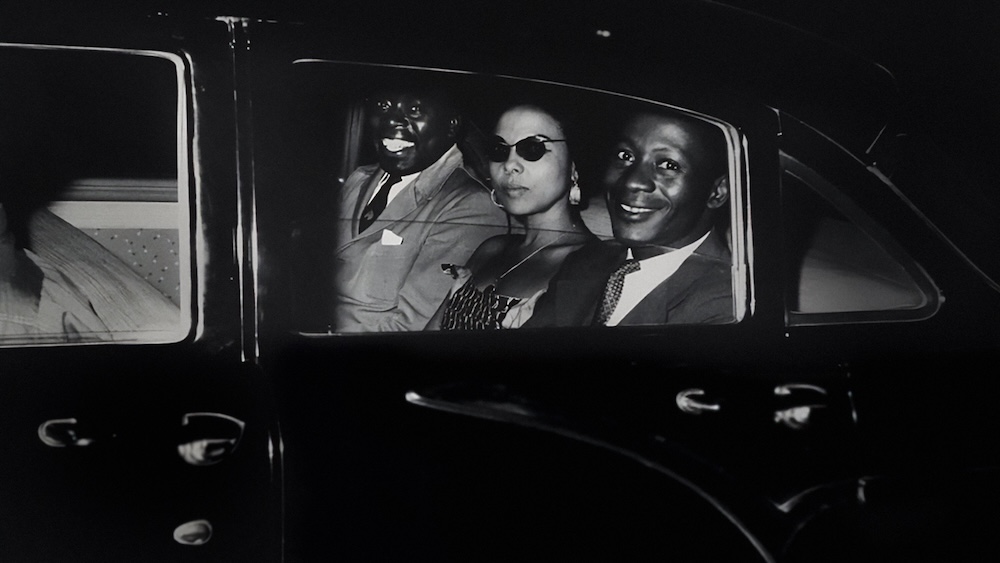
The outright abandonment of liberal internationalism by the Trump administration in 2026 offers an important moment to look back at the nature of US American foreign policy in the depths of the Cold War itself, when the United States at least maintained the veneer of liberal democracy as an ideal in an effort to draw distinctions between capitalism and communism. The US stood, at least in principle and sometimes in actual practice, for freedom in the face of totalitarianism, for self-determination and independence in the face of control and manipulation, for humanitarian dignity in the face of callous suffering. There were many moments when the Cold War motivated decency and real commitments in US foreign policy, and even as hypocritical rhetoric, liberal internationalism held a bit of currency and exerted some power: it kept the US more honest in its actions even if the country also undermined its own ideals repeatedly.
In Johan Grimonprez‘s 2024 documentary film, Soundtrack to a Coup D’Etat, one gets the benefit not only of looking back to the Cold War, but also of listening back to it. The film features the music of US African American jazz and Congolese rumba in dialogue with the story of the CIA-supported assassination of Congolese prime minister Patrice Lumumba and other US-led actions that were anything but liberal or internationalist. Grimonprez presents a daring montage of historical footage, musical sounds, and evocative quotations that together serve as a stark reminder for anyone feeling mistakenly nostalgic about American foreign policy during the Cold War.
It really was no ideal time. Even as the US sometimes committed resources to humanitarian support and independence movements for self-determination, it also undermined any developments if they threatened US interests or tilted even slightly toward the Soviet Union. Liberal consensus often put far more weight on constraining the consensus for to the benefit of some than on realizing liberty for all. There were significant dissonant notes in the soundtrack: strident calls by people around the world and in the US itself for expanding freedom and democracy in a more honest and direct way; forceful assertions of dissent; calls for justice; and efforts to hold the unjust and powerful to account. Yet that was all often momentary counterpoint and contrast. More often than not, Cold War liberal internationalism followed along passively to the steady beat of underlying economic interests and the militaristic flexing of muscle. Nikita Khrushchev might pound his shoe on the lectern at the United Nations, but this rhythm was easily drowned out by the pounding of bombs and the greasing of palms around the world by Western powers (Khrushchev, the Soviet Union, and communists around the world were no angels either, of course).
What gave enormous hope to many, circa 1960, that there could be a way out of the problematic framework of the Cold War was an emergent post-colonial bloc of African and Asian nations, newly independent and seeking out non-alignment when faced with the phony bipolar choices of the Cold War. In Ghana, President Kwame Nkrumah dreamed of a United States of Africa. Indonesian President Sukarno and Indian Prime Minister Jawaharlal Nehru helped to organize the famous 1955 Bandung Conference. In Cuba, and then beyond it, Fidel Castro set a new tone of Third World opposition. In New York City, from the United Nations to Malcolm X in Harlem, voices called for global independence and self-determination, particularly when it came to control of the enormous resource wealth that had made colonialism a thing in the first place.
This is a known story, but Grimonprez does something clever to dramatize it. He incorporates stunning footage of US African American jazz musicians who sought to use their music to register, reflect upon, and contest American Cold War policy both overseas and at home. We see Max Roach and Abbie Lincoln, Charles Mingus, Dizzy Gillespie (who ran for president in 1964 as a gag, but one with serious critique hidden within the joke), Art Blakey, Thelonious Monk, Nina Simone, and others. We get a glimpse of the US State Department’s “Jazz Ambassadors” program, which infuriated Louis Armstrong when the CIA used his visit to the Congo as cover for its covert operations (he threatened to renounce his US citizenship). We also hear from Miriam Makeba, and also some of the Congolese rumba of the era, such as Vicky Longomba, Franco, Dr. Nico, and the bands African Jazz and O.K. Jazz, who all celebrated Congolese independence and new leaders such as Lumumba in sounds that incorporated New World Latin rhythms from Cuba and other Caribbean and South American countries as they bounced back to their African origin point, establishing a new global sonic order that did not follow the old directionalities of conquest and colonization, but instead mutated into more modern forms of sonic combination and assembly.
Grimonprez, however, leaves lots of ambiguity to his presentation. There is no narrator, only a series of clips and some text to narrate the tale. One can hear lots of protest in the music, and in the politics too, but also the lurking dilemma of whether these strident sounds and politics of a post-colonial world were in the end not enough to contest the twin-engine machinery of imperialism and Cold War ideology. After all, the State Department had no problem sending jazz musicians around the world to promote “freedom,” and just basically nodded and smiled when those musicians would raise the hypocrisies of Jim Crow segregation and white supremacy’s continued dominance back in the US itself. Was it all ultimately noise and fury signifying nothing? Surely not, but to raise the question, one of Grimonprez’s most powerful and intriguing ideas is to cut the sound out during musical performances captured on film, so that we only see musicians hitting drums, playing saxophones, or conducting marching bands while mostly there is just silence. The result is a questioning of whether these voices and music could really cut through against the injustice effectively. Silent screams can of course be more potent and communicative than the sounds themselves, perhaps.
Music alone could not forge a counter movement outside of immanent critique within the dominant system, which is not a bad thing, to be clear. Yet it’s worth remembering that many of the same Congolese musicians who sang praise for Lumumba later did so for Mobutu Sese Seko during his dictatorial reign after he helped Belgian and CIA forces assassinate Lumumba. In some songs, they celebrated Mobutu Sese Seko taking up the mantle of the man he helped kill. But one can not really blame them entirely. The alternative for them in the newly named Zaire was likely imprisonment, torture, and death for themselves. Music gets messy, and can be terrifying, when it mixes with politics.
In fact, music gets messy even when it doesn’t. Nonetheless, jazz ambassadors and African musicians were able to register critical commentary, sometimes quite slyly and other times more overtly. That mattered. In moments, they could even articulate outright dissent. At other times, the music provided an undercurrent of non-compliance and non-alignment. It hit sour notes and martial rhythms. It bended discordance back into familiar melodies. It pursued new harmonic convergences that stretched the ear and asked us to listen for unexpected reimaginings of what it could mean to be more fully human, modern. As drummer Max Roach said of his fellow drummer Art Blakey, in words that brought music and politics together, “Art Blakey was the perhaps the best at maintaining independence with all four limbs.” The music protested and provided a soundtrack for refusing to fit into the existing order even as the existing order of liberal internationalism proved quite flexible in accommodating and appropriating the sensibility of non-alignment that the music encompassed.
Today, times are different. Or are they? As the neoliberal world order that replaced the Cold War after the early 1990s itself devolves, ripped asunder by incoherent Trumpian bellicosity, Chinese assertions of world power, Saudi fossil-fuel cash money, and Putin-led Russian angling to maintain global presence, the soundtrack itself is now less clear. Are we witnessing a new kind of coup d’etat within the former imperial powers themselves? How does music fit into this new dynamic? Does it still provide a soundtrack? If so, for what should we be listening? Or, has music itself, as a form of commodity culture or political protest or social consciousness, fundamentally changed along with the geopolitical dynamics of an earlier moment in history?
One thing remains the same: as Trump complains that the US should take over Greenland because of its rich mineral resources and its key geographic location as a gateway to the Arctic, and as he attempts to wield control over the oil fields of Venezuela and other locales in new forms of outright imperial exploitation with no front of liberal internationalism to mask his intentions, one is reminded of the contest over the Congo itself back in the heat of the Cold War moment. The US and the USSR perhaps only really cared about the Congo because the mines in Katanga produced key resources for both conventional and atomic weaponry. Today, those same exploited mines produce key components for cell phones and other technology. It’s the same stuff as it always was. Raw resources remain even after the liberal internationalism fades. Extraction was and continues to be the name of the game, whatever global system emerges around the roar of the bulldozers and backhoes, pickaxes and shovels. Those noises always threaten to drown out both the music or the sounds of political debate.
It was Lumbumba, after all, who tried to wrest control of those resources from the colonial power of Belgium. In response, while parroting the platitudes of liberal internationalism, the United States, along with England and Belgium, had no problem strategically pitting ethnic groups against each other, paying off corrupt officials, and undermining Lumumba’s efforts at self determination and liberty for the Congo. They were willing to see him assassinated if necessary, liberal internationalism be damned.
Maybe, in a strange way, Trump’s erratic foreign policy brings to the surface qualities that have always been present in US foreign policy. The question is, as it was already back in the Cold War: what can a soundtrack do in relation to the geopolitical plots it accompanies? Can it orchestrate something different? Can a soundtrack ever do more than merely chase the main story, ever subservient to it. If so, wouldn’t that be a coup?